
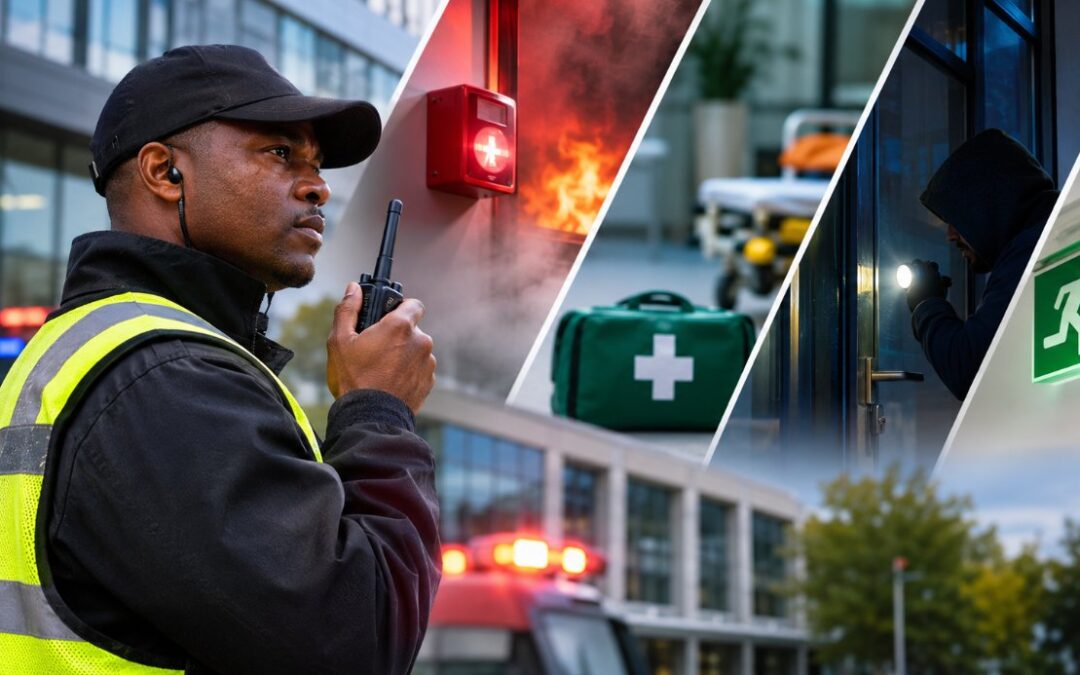
Emergencies rarely happen at convenient times.
A fire can start during a busy working day. A medical emergency can happen in a car park. A break-in may occur after hours. Suspicious activity might be noticed just as employees are arriving for work. A security incident can develop quickly, leaving people with very little time to decide what to do next.
For South African businesses, having clear emergency procedures is essential. However, procedures are only one part of the equation. Having trained security personnel physically present on the premises can provide another important layer of support when something unexpected happens.
Security guards are often among the first people to notice that something is wrong. Their ability to remain alert, communicate quickly and follow established procedures can help businesses respond more effectively while the appropriate emergency services are contacted.
Prevention starts before an emergency
The role of a professional security officer during an emergency begins long before the emergency itself.
Regular patrols, access control, monitoring and observation can help identify potential risks before they develop into serious incidents.
A security officer might notice a damaged electrical installation, an obstructed emergency exit, suspicious activity near a restricted area or a gate that is not securing properly.
Reporting these issues allows management to address them before they become more significant.
This proactive approach is an important part of emergency preparedness. The best emergency response is often the one that never needs to happen because a potential problem was identified and addressed early.
Responding to a fire
Fire is one of the emergencies that can develop particularly quickly.
A security officer may be among the first people to notice smoke, flames or a fire alarm. Depending on the property’s procedures and the officer’s training, they can raise the alarm, contact the appropriate emergency services, assist with controlling access and support the evacuation process.
Security personnel can also help ensure that people do not unnecessarily re-enter an affected building or area.
The priority during a fire should always be the safety of people. Security officers are not a replacement for firefighters, but they can play an important supporting role while emergency services are responding.
Having someone who knows the property, understands the emergency procedures and can communicate clearly can be extremely valuable during those first moments.
Supporting medical emergencies
Medical emergencies can happen anywhere, including workplaces, offices, warehouses, factories and commercial properties.
An employee, visitor, contractor or member of the public may suddenly become unwell or suffer an injury.
A security officer may be among the first people called for assistance.
Their role will depend on their training and the procedures established by the business, but they can assist by contacting emergency medical services, providing clear information about the location and helping manage the surrounding area.
Keeping the area clear can also allow medical professionals to reach the person more easily when they arrive.
Again, security personnel do not replace qualified medical professionals. Their value lies in helping coordinate the immediate response and ensuring that appropriate assistance is contacted as quickly as possible.
Dealing with suspicious activity
Not every security concern becomes an emergency, but suspicious activity should never be ignored.
A security officer may notice an unfamiliar individual attempting to access a restricted area, a vehicle behaving unusually or activity that does not appear consistent with normal operations.
The appropriate response will depend on the circumstances and the site’s procedures.
Professional security personnel can observe the situation, follow established protocols, notify supervisors or management and contact the relevant authorities where necessary.
Importantly, this does not mean jumping to conclusions.
Good security requires observation and sound judgement. An unusual situation should be assessed carefully rather than treated as automatically criminal.
Supporting evacuations
During an emergency, confusion can make an already difficult situation worse.
Employees and visitors may not know which exit to use, where to assemble or whether they are allowed to return to the building.
Security personnel can support established evacuation procedures by helping direct people towards designated areas, controlling access and communicating relevant information.
They may also assist with keeping emergency routes clear and preventing unauthorised people from entering affected areas.
For larger properties, having security personnel positioned at strategic points can provide additional support during an evacuation.
Responding to break-ins
A break-in can be stressful for everyone involved.
Security personnel may detect an attempted intrusion through patrols, CCTV monitoring, alarms or other security measures.
If an intrusion is identified, the security response should focus on following the established procedures, protecting people, securing the area where possible and contacting the appropriate authorities.
Security officers should never be expected to take unnecessary risks or place themselves in danger.
Professional security is about making sensible decisions under pressure and knowing when an incident needs to be escalated.
Communication is critical
During an emergency, communication can make all the difference.
Security officers may need to communicate with supervisors, business management, employees, emergency services and other relevant parties.
Information needs to be clear and accurate.
Where possible, security personnel should be able to provide details such as what happened, where it happened, when it was noticed and whether anyone appears to be in immediate danger.
Good incident reporting after the event is also important. Once the immediate situation has been resolved, an accurate record can help management understand what happened and identify opportunities to improve future preparedness.
Every site needs its own emergency plan
There is no universal emergency response plan that works for every business.
A multi-storey office building has different requirements from a warehouse. A manufacturing facility has different risks from a retail property. A business park may need to consider multiple buildings, parking areas and access points.
Security personnel should therefore understand the specific procedures that apply to the property they are protecting.
This includes knowing emergency exits, assembly areas, important access points, restricted areas and the correct escalation procedures.
The more familiar security personnel are with the site, the more effectively they can support the business when an emergency occurs.
Training and preparedness matter
Emergencies are not the time to discover that nobody knows what to do.
Regular training, clear procedures and communication between the security company and the client can help create a more prepared environment.
Security personnel should understand their responsibilities and know how to escalate incidents appropriately.
Businesses should also review their emergency procedures periodically. Changes to the building, staff numbers, operating hours, access points or equipment may require changes to the emergency plan.
Preparedness is an ongoing process rather than a once-off exercise.
A calm presence can make a difference
Emergencies can be frightening.
People may panic, become confused or struggle to know what action to take. A professional security officer can provide a calm and organised presence during a difficult situation.
Their role is not to be a superhero, and they should never be expected to take unnecessary risks. Their role is to observe, communicate, follow procedures and support the appropriate response.
That can be incredibly valuable.
For South African businesses, professional security guarding provides more than protection against crime. It can also provide an important layer of support when unexpected situations occur.
From fire incidents and medical emergencies to suspicious activity, evacuations and break-ins, trained security personnel can help businesses respond in a structured and responsible way.
Because while nobody wants an emergency to happen, being prepared for one can make all the difference when it does.
As shared on LinkedIn
🚨 WHEN AN EMERGENCY STRIKES, EVERY SECOND COUNTS!
Security is about more than preventing crime. It’s also about being prepared for the unexpected.
🔥 A fire breaks out during working hours.
🚑 An employee experiences a medical emergency.
🚨 Suspicious activity is detected on your premises.
🚪 An evacuation needs to be managed quickly and safely.
🔒 An attempted break-in occurs after hours.
In situations like these, having trained security personnel on-site can make a significant difference.
Professional security officers are often the first to notice when something is wrong. Their ability to remain calm, communicate effectively, follow emergency procedures and coordinate with the relevant authorities provides businesses with an additional layer of support when it matters most.
At Bolwa Security Services, we understand that effective security isn’t simply about responding to threats. It’s about vigilance, preparedness, professionalism and protecting the people and businesses entrusted to our care.
📖 In our latest blog, “From Prevention to Response: How Security Guards Support Businesses During Emergencies”, we explore the important role security personnel play in emergency preparedness, incident response and maintaining a safer business environment.
🛡️ Is your business prepared for the unexpected?
Partner with Bolwa Security Services for professional, reliable and tailored security solutions designed to safeguard your people, property and operations.
📞 086 1112 231 📧 info@bolwasecurityservices.co.za 🌐 bolwasecurityservices.co.za
Bolwa Security Services | Absolute Safety. No Compromise.
#BolwaSecurityServices #SecurityGuarding #EmergencyPreparedness #BusinessSecurity #SecurityManagement #RiskManagement #EmergencyResponse #WorkplaceSafety #SouthAfricanBusiness