
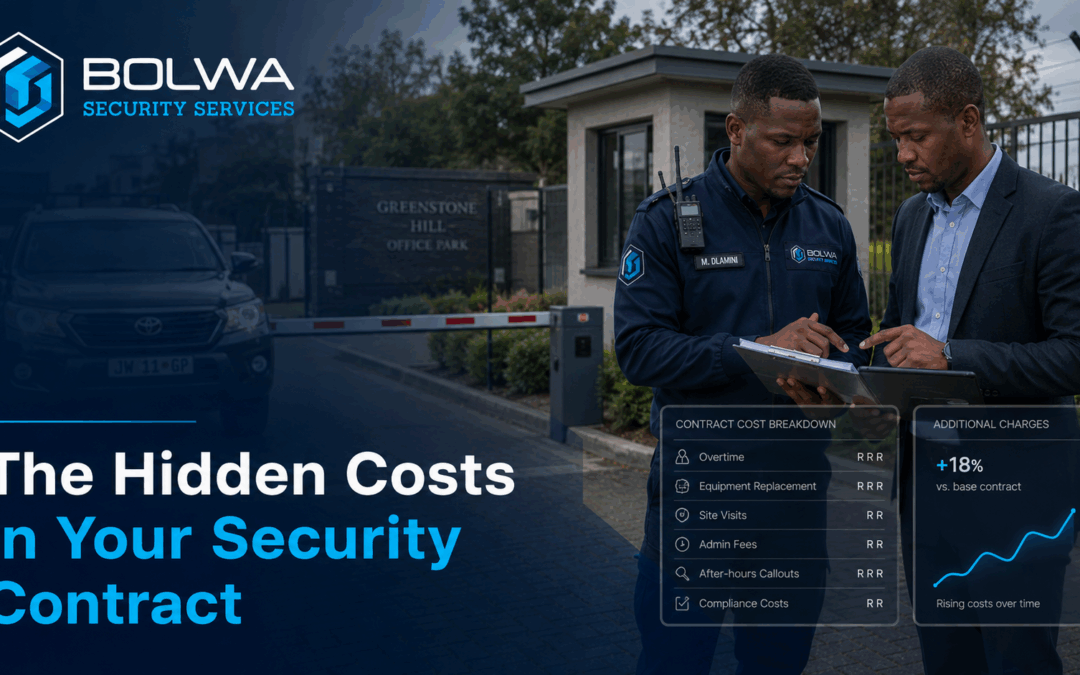
The cheapest quote you got was probably not the cheapest contract. South African security contracts have a habit of stacking small line items that look minor on paper and add 15 to 30 percent to your monthly bill by the end of the first quarter. This piece names the seven most common hidden costs, gives real R-amount examples, and shows you how to read a contract before signing instead of after.
The quick answer
The seven line items to watch for are: emergency call-out fees, public holiday and Sunday premiums, supervisor visit charges billed per visit, leave-replacement billing tricks, equipment and uniform allowances, communication and control room fees, and annual escalation clauses tied to PSIRA-plus-inflation. Get every one of them named, capped or excluded in writing before you sign.
The seven line items most contracts bury
1. Emergency call-out fees
Almost every contract includes a clause that says “additional officers may be deployed in emergencies at the company’s standard call-out rate”. That standard rate is usually R450 to R900 per hour per officer, and most contracts do not cap how often it can be invoked. One alarm-activation call-out with three armed officers for two hours is R5,400. Three of those in a month and you have just added R16,000 to your bill on top of the regular guarding cost.
What to demand: Either a fixed monthly inclusive rate for emergency deployment, or a named cap on emergency hours per month. Anything else is a blank cheque.
2. Public holiday and Sunday premiums billed separately
The PSIRA wage determination requires guards to be paid more for Sunday and public holiday shifts. That is correct. The trick is whether that cost is built into your monthly quote or billed on top as a “shift premium adjustment”. South Africa has 12 public holidays a year. If your site runs 24/7, that is roughly 36 guard-shifts of premium pay annually.
A typical premium is 50 percent of the day rate, which on a R4,500 monthly day rate works out to about R75 per shift extra. Multiply by 36 shifts and three guards covering a 24-hour post: that is an extra R8,100 a year not in your quote.
What to demand: Quote must state explicitly that all public holiday and Sunday premiums are included in the monthly fee, not billed separately.
3. Supervisor visits billed per visit
Supervisor overlay is supposed to be part of the service. Some companies quote a low headline number, then bill supervisor visits separately at R250 to R500 per visit. If the contract says “two supervisor visits per 12-hour shift”, that is four visits a day, 120 a month, and at R350 each you have just added R42,000 to your annual bill on supervision alone.
What to demand: Supervisor overlay must be included in the monthly fee. Specify visit frequency in the contract. No per-visit billing.
4. Leave replacement billing tricks
Every guard takes leave. Every guard takes sick days. The question is who covers their post and at what rate. Three common tricks:
- Trick A: The company bills you the Grade B rate for the regular officer, then sends a Grade D officer to cover their leave at no rate reduction. You pay Grade B for Grade D coverage during 18 days of the year (typical annual leave plus sick).
- Trick B: The company bills “replacement officer surcharge” of R800 to R1,200 per leave day on top of the regular monthly fee. Triple charging.
- Trick C: The contract is silent on leave coverage, and when the regular officer is off, the post simply runs short until they come back.
What to demand: Contract must state that leave replacement is included in the monthly fee, must be the same PSIRA grade as the regular officer, and must be covered at the same standard.
5. Equipment and uniform allowances
Some companies charge a monthly “equipment levy” of R150 to R400 per officer, ostensibly for radios, body cameras, phones, panic devices and uniforms. The trick is that the equipment was already accounted for in the basic guarding rate. The levy is pure margin top-up.
Worse: some contracts deduct uniform costs from the guard’s wage (technically illegal in some configurations under the BCEA) and ALSO charge the client an equipment levy.
What to demand: Equipment, uniforms and standard communication devices included in the monthly rate. No separate equipment levy. Any specialised equipment (body cameras, biometric scanners, K9 handler kit) must be quoted explicitly upfront.
6. Communication and control room fees
Some companies charge a separate “control room subscription” or “communication fee” of R250 to R700 per post per month. This is supposed to cover the cost of the dispatch centre receiving your guards’ reports.
Reality check: if the company is operating a real control room, that cost is part of the business overhead and should be in the headline rate. If they are charging it as an extra, ask to see the control room. If you cannot see it, you are paying for a WhatsApp group.
What to demand: Control room overlay must be specified, located physically (an address), and included in the monthly fee. If they cannot show you the control room, the line item is fiction.
7. Annual escalation clauses
Most South African guarding contracts include an annual price escalation linked to either the PSIRA wage determination increase or CPI plus a margin. PSIRA typically increases minimum wage rates by 6 to 8 percent annually. Inflation is currently around 5 percent. A typical contract clause reads: “Fees shall escalate annually by PSIRA wage determination plus 3 percent.”
That clause means your R15,000 monthly post becomes about R16,500 in year two, R18,150 in year three, and R20,000 by year four. Make sure the clause is fair (PSIRA-linked is reasonable, PSIRA-plus-CPI-plus-margin is greedy) and that you have a re-negotiation right if the escalation exceeds a certain threshold.
What to demand: Escalation linked to a named, public benchmark (PSIRA wage determination) with no opaque “plus” margin. Right to re-negotiate if escalation exceeds a defined ceiling.
Real example: a R45,000 contract that became R58,000
A property manager we work with took over an estate from another security company in 2025. The previous contract was R45,000 a month for a two-post guarding setup. They asked us to audit the bills from the previous company over the last twelve months. The breakdown of the average month:
- Base guarding fee: R45,000
- Emergency call-outs: R3,200 (averaged across the year)
- Public holiday adjustments: R1,800 (annualised monthly)
- Supervisor visit fees: R4,500 (180 visits at R250)
- Equipment levy (3 officers): R900
- Control room subscription: R1,200
- Annual escalation already kicked in mid-year: R1,300
Total actual monthly cost: about R58,000. 29 percent higher than the headline rate. Nothing about the bills was technically illegal. Everything was in the contract. The property manager just had not read the contract carefully.
How to read a security contract before signing
Use this six-point read-through every time:
- Find every “additional fee” clause. Search the contract for the words “additional”, “supplementary”, “out-of-scope”, “call-out”, “surcharge”, “levy”, “adjustment”. Each one is a potential line-item add-on. Demand each one be either included or capped.
- Find the leave coverage clause. If it does not exist, ask for it. If it exists but does not name a grade-match, demand the change.
- Find the escalation clause. Calculate what the contract will cost in year two and year three. If you cannot live with that number, renegotiate now.
- Find the cancellation clause. Standard is 30 to 60 days. Anything longer is unusual. Anything with a “minimum term” lock-in is a red flag.
- Find the SLA / performance clauses. If the contract does not commit the company to anything measurable (incident response times, supervisor visit frequency, reporting cadence), you have no recourse when things go wrong.
- Find the wage transparency clause. If the contract does not state what the company is paying your assigned guards, you have no defence against the cheap-tender-then-cut model.
What a clean contract looks like
A clean South African guarding contract in 2026 has one all-in monthly fee, a named list of officers with their PSIRA grades and wages, an explicit supervisor visit schedule, a named leave-replacement structure with grade-match, an escalation clause tied to a public benchmark, a cancellation clause of 30 days, performance SLAs that are measurable, and zero “additional fees” hidden in the small print.
If your current contract does not look like that, you are not buying guarding. You are buying a starting price that quietly grows.
Frequently asked questions
Are these hidden costs illegal?
Almost never. They are in the contract. You signed the contract. The trick is that the headline rate is what gets compared in the tender, and the line items only become visible once the bills start arriving. Read the small print before you sign.
What is a reasonable annual escalation rate in 2026?
PSIRA wage determination plus zero is fair. PSIRA plus 1 to 2 percent is acceptable to cover the company’s own non-wage cost inflation. PSIRA plus 3 percent or more is greedy. Multi-year contracts with escalation clauses should always include a re-negotiation right if escalation exceeds a defined ceiling.
How do I audit my current contract for hidden costs?
Pull twelve months of invoices. Add every line item that was not in the base monthly fee. Divide by twelve. That is your real monthly cost. Compare it to your contract’s headline rate. The gap is your hidden cost percentage.
Can I renegotiate mid-contract if I find hidden costs?
You can ask. Some companies will adjust. Most will point to the contract. Your real leverage is the cancellation clause: give written notice of the issues, request a remediation proposal, and if you do not get a fair adjustment, switch at the next break point.
Does Bolwa quote with hidden costs?
No. Our quotes are line-itemised so you can see exactly what is and is not included, and we will walk you through every line before you sign. Ask us to confirm in writing how leave replacement, supervision, equipment and annual escalation are handled on your contract determination. The total on month one is the total on month twelve unless something material changes on the site.
Get a Clean Line-Itemised Quote
No hidden levies, no surprise call-out fees, no grade-mismatched leave cover. Free site assessment, written proposal delivered promptly.