
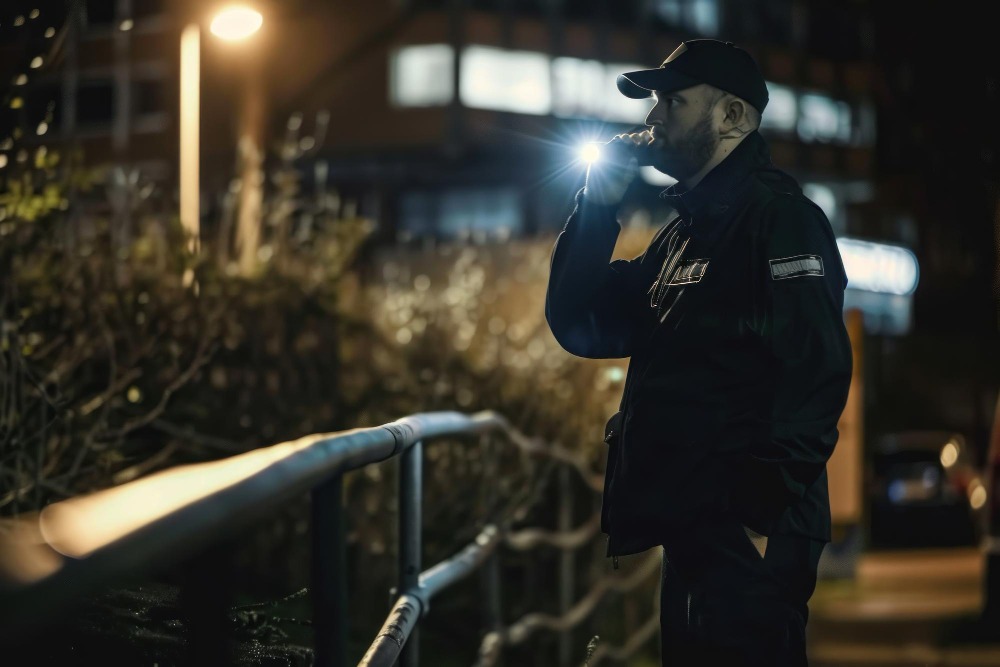
Night-shift guarding in Gauteng costs 10–20% more than day shifts due to legal requirements, not industry preference. The Basic Conditions of Employment Act mandates night-shift allowances, transport provision, and health assessments for guards working between 18h00 and 06h00. Combined with PSIRA wage structures, geographic premiums for Areas 1 and 2, and operational overheads, these factors create measurable cost differences estate managers and business owners need to budget for.
Summary
- Night premiums are legally required – The BCEA doesn’t leave shift allowances optional. Guards working after 18h00 must receive compensation through allowances (typically 10% of base wage) or reduced hours with full pay.
- Transport is non-negotiable – Employers must provide or arrange safe, reliable transport for guards finishing shifts after 18h00. This cost is baked into night-shift pricing whether you see it itemized or not.
- Gauteng sits in PSIRA’s premium zone – Johannesburg, Pretoria, Centurion, Midrand, and surrounding magisterial districts fall into Areas 1 and 2, where minimum wages are higher than Area 3 (rural regions).
- Fixed costs don’t disappear at night – Supervision, insurance, PSIRA fees, and administrative overheads apply equally to night shifts, but with fewer billable hours across a company’s guard force, per-shift costs rise.
- Expect 15–25% markup over day rates – When you account for shift allowances, transport, supervision intensity, and operational realities, night guarding legitimately costs more. Understanding why helps you evaluate quotes accurately.
Table of Contents
Why Night Guards Cost More (It’s Not Just Because It’s Dark)
Here’s a question that lands in every estate manager’s inbox and every facilities budget meeting: “Why does the same guard cost R200 more per shift at night than during the day?”
It feels like a markup for inconvenience. After all, the guard’s doing the same job, walking the same perimeter, checking the same gates. Why should darkness come with a 20% price increase?
The answer isn’t complicated. It’s a combination of labour law, practical realities, and cost structures that don’t vanish when the sun goes down. Understanding these factors helps you distinguish between legitimate pricing and companies padding invoices.
Let’s break down exactly where night-shift premiums come from, what you’re legally obligated to pay for, and how Gauteng’s specific cost environment affects your security guarding solutions.
The Legal Foundation: What the BCEA Actually Requires
South Africa’s Basic Conditions of Employment Act (BCEA) defines night work as any work performed between 18h00 and 06h00 the next day. That’s not industry convention. It’s law.
And the BCEA doesn’t just acknowledge that night work happens. It mandates specific protections and compensation for employees working those hours.
Night-Shift Allowances Are Compulsory
Section 17(2) of the BCEA states that employees earning below the threshold (currently R261,748.45 per year as of 1 April 2025) may only work night shifts if they receive compensation by payment of an allowance or by a reduction of working hours.
Here’s what that means in practice:
Option 1: Night-shift allowance
The guard receives an additional percentage on top of their base wage for hours worked between 18h00 and 06h00. The BCEA doesn’t specify an exact percentage, which means it’s negotiable between employer and employee. However, industry standards hover around 10–20% of the base hourly rate, with 10% being the most common baseline.
For security guards specifically, the Private Security Sector Bargaining Council agreements indicate night-shift allowances of approximately R6.00 per shift (2024 rates, incrementing to R8.00 per shift by 2027). Some contracts structure this as a flat per-shift amount, others as a percentage.
Option 2: Reduced working hours
Instead of paying an allowance, the employer reduces the guard’s shift length but pays them for the full shift. For example, a guard works seven hours but is paid for nine hours.
Most guarding companies use Option 1 (allowances) because reduced hours create coverage gaps and complicate scheduling. But both options cost the employer more than standard day-shift wages.
Transport Provision Is Mandatory
This is the part many property managers don’t realize they’re paying for.
Section 17(2)(b) of the BCEA is unambiguous: employers may only require employees to work night shifts if “transportation is available between the employee’s place of residence and the workplace at the commencement and conclusion of the employee’s shift.”
Notice it doesn’t say “transport must be provided.” It says “transportation must be available.” But the Labour Court has interpreted this to mean employers have a positive obligation to ensure transport is safe, reliable, and affordable. Simply saying “public transport exists” doesn’t meet the standard.
For guards finishing shifts at 02h00 or 06h00, this typically means:
- Company-arranged transport (shuttle services, contracted taxis)
- Transport allowances sufficient to cover safe travel (not just the cheapest option)
- On-call transport for emergency shift changes or early finishes
Why this drives costs up:
Guarding companies operating across Gauteng must either run their own shuttle fleets (capital costs, fuel, maintenance, drivers) or contract with transport providers. Either way, those costs get passed to clients as part of the night-shift rate.
A guard working in Midrand who lives in Tembisa needs transport at 06h00 when their shift ends. That’s not a one-off cost. It’s a daily, contractual obligation built into pricing.
Health Assessments for Regular Night Workers
If guards work regularly after 23h00 (defined as at least five times per month or 50 times per year), the BCEA requires employers to:
- Inform guards of health and safety hazards associated with night work
- Provide access to medical examinations at the employer’s expense
- Transfer guards to day work if they develop health conditions related to night shifts (if practically possible)
These aren’t massive per-shift costs, but they’re real operational expenses that day-shift-only operations don’t carry.
PSIRA Wage Structures and Geographic Premiums
The Private Security Industry Regulatory Authority (PSIRA) doesn’t just regulate guard training and registration. It also influences wage structures through sectoral determinations and bargaining council agreements.
Area-Based Wage Differentials
South Africa’s security sector divides the country into geographic wage zones:
Areas 1 and 2 (major metros)
Magisterial districts including Johannesburg, Pretoria, Centurion, Midrand, Randburg, Roodepoort, Sandton, Benoni, Boksburg, Germiston, Kempton Park, Alberton, Springs, and other Gauteng centres. These areas command higher minimum wages due to cost of living and operational expenses.
Area 3 (rural and less economically active regions)
All other magisterial districts not specified in Areas 1 and 2.
For 2024–2025, a Grade C security officer (the standard for most estate and office park guarding) earns:
- Areas 1 & 2: Approximately R5,036 per month minimum (R25.42 per hour based on standard shifts)
- Area 3: Approximately R4,786 per month minimum
That’s a R250 monthly difference for the same grade and same work, purely based on geography.
If you’re hiring guards for properties in Pretoria East, Centurion CBD, Midrand office parks, or Johannesburg suburbs, you’re paying Area 1/2 rates. Night-shift premiums then stack on top of these already elevated base wages.
Grade-Based Pay Scales
PSIRA grades guards from E (entry-level) to A (armed, tactical, supervisory). Most residential and commercial guarding requires Grade C, which covers:
- Access control (gate, boom, pedestrian entry)
- Perimeter patrols
- Incident response and reporting
- Basic surveillance and monitoring
Grade C minimum wages are government-mandated. You cannot legally hire a Grade C guard in Areas 1/2 for less than the sectoral minimum, and night-shift allowances stack on top of that floor.
What this means for your budget:
A property in Centurion paying for 24/7 guarding isn’t just paying “guard wages.” You’re paying:
- Area 1/2 minimum base wages (higher than rural areas)
- Night-shift allowances (10–20% premium for 18h00–06h00 hours)
- Transport provision (legally required)
- PSIRA registration and compliance costs
- Operational overheads (supervision, insurance, admin, control room access)
Each layer is legitimate, legally mandated, and unavoidable.
The Real Costs Behind Night-Shift Pricing
Let’s talk about what guarding companies don’t always itemize but absolutely incur when providing night coverage.
Supervision Intensity Increases at Night
Day-shift guards work when estate managers are on-site, tenants are active, and incidents get noticed and reported quickly. There’s ambient oversight.
Night-shift guards work in relative isolation. Supervisors can’t just “swing by” the site at 03h00 to check on patrol compliance. Instead, guarding companies invest in:
- Control room oversight with 24/7 monitoring (see our CCTV monitoring services for how this integrates)
- Roving supervisors who visit multiple sites during night shifts
- Remote check-in systems (guards calling in at intervals)
- Incident escalation protocols with after-hours management contacts
All of these cost more per billable guard-hour than day-shift supervision because the supervisor-to-guard ratio is lower (guards are spread across more sites) and infrastructure costs (control rooms, vehicles, fuel) don’t scale linearly.
Insurance and Liability Premiums
Night shifts carry higher incident risk not because guards are less capable, but because:
- Criminals preferentially target properties at night when visibility and witness presence are lower
- Response times (SAPS, armed response, medical services) can be slower during late-night hours
- Fatigue-related errors increase statistically during overnight shifts
Insurance companies price this risk into liability premiums. A guarding company insuring its operations pays more to cover night-shift incidents than day-shift incidents, and that cost flows into client pricing.
Uniforms, Equipment, and Operational Wear
Guards working 12-hour night shifts go through equipment faster than 8-hour day shifts. Torch batteries, uniform wear, two-way radio usage, vehicle wear on patrol vehicles—it all compounds.
More significantly, night shifts require equipment redundancy. If a guard’s torch fails during a day shift, it’s an inconvenience. If it fails at 02h00 during a perimeter patrol, it’s a security failure. Guarding companies budget for backup equipment, spares, and faster replacement cycles for night operations.
Relief Guard Availability
When a night-shift guard calls in sick at 17h30, the guarding company has one hour to find a replacement or leave your site unguarded. Maintaining a pool of relief guards available for emergency night-shift call-outs costs significantly more than day-shift relief because:
- Fewer guards prefer night work (it disrupts family life, social commitments, and long-term health)
- Relief guards on night standby often receive retainer payments even when not deployed
- Emergency call-out rates are higher to compensate for short-notice availability
These costs get amortized across all night-shift clients, not just the ones who use relief guards.
Gauteng-Specific Cost Drivers
Gauteng isn’t just Area 1/2 for wage purposes. It’s also a unique operational environment that affects guard costs in ways that don’t apply to smaller cities or rural deployments.
Traffic and Fuel Costs
Johannesburg and Pretoria’s traffic congestion means supervisor site visits take longer and burn more fuel per site visited. A supervisor managing six sites across Midrand, Centurion, and Pretoria East might spend three hours in transit during a single night-shift oversight round.
With fuel prices fluctuating above R23 per liter and vehicles covering 150–200km per night per supervisor, fuel alone adds R5,000+ per month per supervisor vehicle to operational costs.
Higher Cost of Living Means Higher Wage Expectations
While PSIRA sets minimum wages, guards in Gauteng’s competitive labour market often earn above those minimums. Companies competing for quality guards (reliable, experienced, PSIRA-compliant personnel) pay market rates, not just legal minimums.
A Centurion estate competing with office parks, retail centres, and event security clients for the same pool of Grade C guards will see prices reflect supply and demand, especially for night shifts where guard availability is tighter.
Load-Shedding Contingencies
This is uniquely South African: load-shedding affects night-shift operations more acutely than day shifts because:
- Boom gates, access control systems, and alarm panels run on backup batteries that may exhaust during extended outages
- Guards require functional torches, charged radios, and operational patrol vehicles—all of which depend on recharged batteries
- Control room monitoring systems need generator backup, adding infrastructure and fuel costs
Guarding companies in Gauteng build load-shedding resilience into pricing through generator maintenance budgets, backup equipment inventory, and contingency protocols. These costs are real, measurable, and higher at night when load-shedding stages tend to be most severe.
Crime Rate and Incident Frequency
Gauteng’s crime statistics influence both insurance premiums and operational intensity. Properties in high-crime metros require:
- More frequent patrols (every hour vs. every two hours)
- Armed response coordination (additional contracted costs)
- Higher-grade guards (Grade B supervisors overseeing Grade C personnel)
- Enhanced training and equipment (defensive tools, communication redundancy)
All of these escalate night-shift costs because criminal activity is demonstrably higher between 22h00 and 04h00 than during daylight hours.
What You’re Actually Paying For: A Typical Night-Shift Cost Breakdown
Let’s make this concrete. Here’s what a 12-hour night-shift guard (18h00–06h00) costs a guarding company to deploy in Gauteng’s Area 1/2 region, and why your invoice reflects these costs.
Assumptions:
- Grade C guard, Area 1/2 minimum wage (R5,036/month)
- 208 working hours per month (26 days × 8-hour equivalent)
- 10% night-shift allowance
- Transport provision via contracted shuttle
- Standard operational overheads
| Cost Component | Amount (per shift) | Explanation |
|---|---|---|
| Base Wage | R291 | R5,036 ÷ 208 hours × 12 hours |
| Night-Shift Allowance (10%) | R29 | Legally required BCEA compensation |
| Transport (return trip) | R80 | Contracted shuttle or taxi allowance for safe transport |
| Supervisor Oversight | R35 | Pro-rata share of roving supervisor + control room monitoring |
| Insurance & Liability | R28 | Public liability, employee injury, operational risk coverage |
| Uniforms & Equipment | R18 | Torch, radio, uniform amortization over operational life |
| PSIRA Fees & Compliance | R22 | Annual registration fees, training updates, medical assessments |
| Admin & Payroll | R25 | HR, payroll processing, compliance documentation, dispute resolution |
| Overheads (facilities, vehicles, backup guards) | R62 | Office space, patrol vehicles, fuel, relief guard retainers, IT systems |
| Company Margin | R65 | Operational profit after all costs (typically 8–12% in competitive markets) |
| TOTAL COST PER 12-HOUR NIGHT SHIFT | R655 |
Compare this to a day-shift equivalent: you’d save the R29 night allowance and likely R30–40 on transport (day-shift transport is still required by BCEA after 18h00, but guards finishing at 18h00 have more public transport options than those finishing at 06h00). You’d still pay everything else.
Net difference: R60–70 per 12-hour shift, or approximately 10–12% premium for night coverage.
That aligns with the 10–20% industry-standard markup, but now you understand it’s not arbitrary.
How to Evaluate Night-Shift Quotes (Without Getting Played)
Not all night-shift pricing is created equal. Here’s how to assess whether you’re getting fair market rates or being overcharged.
Red Flags That Indicate Overpricing
Night premiums above 25%:
If a guarding company quotes day shifts at R450 per 12-hour shift and night shifts at R600+ (33% markup), ask for a detailed cost breakdown. Legal requirements don’t justify that gap unless site-specific factors (extreme remote location, high-risk environment, specialized skills) apply.
Transport “allowances” that don’t match actual costs:
If you’re quoted R150 per shift for transport but guards live within 15km of your site and Uber quotes show R60 return trips, someone’s padding the bill.
Vague “night operational costs”:
Generic line items like “night premium” or “after-hours fee” without granular breakdowns suggest the company is either lazy or hiding inflated margins. Professional providers itemize supervision, insurance, transport, and allowances separately.
No PSIRA compliance transparency:
If a quote doesn’t reference guard grades, PSIRA registration numbers, or sectoral minimum wages, you’re likely dealing with a non-compliant operator who may be underpaying guards (illegal) or employing unregistered personnel (also illegal).
Green Flags That Indicate Fair Pricing
Itemized cost breakdowns:
Companies that voluntarily show you base wage, night allowance, transport provision, and overhead allocations are confident their pricing stands up to scrutiny.
Alignment with sectoral minimums:
Check your quote against current PSIRA rates. If base wages are at or slightly above sectoral minimums, the company is compliant and competitive.
Transparent transport solutions:
Whether it’s a shuttle service, contracted taxis, or transport allowances, good providers explain how guards get to/from site safely and legally.
Supervision and reporting protocols:
If your quote includes control room access, supervisor site visits, and digital reporting systems, you’re paying for active oversight, not just warm bodies at the gate.
Willingness to negotiate on scope, not wages:
Ethical companies will discuss patrol frequencies, coverage hours, or equipment specs to match your budget, but they won’t undercut legally mandated wages or allowances. If a company offers to “waive the night premium,” they’re planning to violate labour law or pay guards illegally—and that liability eventually lands on you.
Alternative Approaches to Managing Night-Shift Costs
If night-shift premiums are straining your budget, here are legitimate ways to optimize costs without compromising security or legality.
1. Hybrid Coverage Models
Not every hour of the night requires active guarding. Consider:
- Full guarding 18h00–24h00 (high-activity period: residents returning, evening visitors, contractor sign-outs)
- Patrol-based coverage 00h00–06h00 (roving vehicle patrols every 1–2 hours instead of static guard presence)
- Technology augmentation (automated access control, CCTV monitoring, perimeter alarms) reducing required guard hours
This approach cuts 6 hours of premium-rate night guarding per night while maintaining visible security.
2. Consolidate Shift Timing to Minimize Night-Hour Overlap
Instead of 18h00–06h00 coverage, consider:
- Morning shift: 06h00–18h00 (12 hours, no night premium)
- Evening shift: 18h00–22h00 (4 hours, night allowance applies)
- Patrol coverage: 22h00–06h00 (roving checks, lower cost per hour than static guarding)
You’ve just cut 8 hours of full night-premium pay per 24-hour cycle.
3. Shared Security Arrangements
If you’re part of a business park, retail complex, or clustered estates, explore cost-sharing models where multiple properties split the cost of roving night patrols. One guard vehicle covers 3–5 properties instead of each paying for dedicated static guards.
This works particularly well for office park security where after-hours activity is minimal and visible deterrence matters more than constant presence.
4. Invest in Force Multipliers
Spending R50,000 on perimeter beam sensors, automated gate systems, and AI-enabled camera analytics can reduce required guard hours by 30–40% while improving coverage quality. The upfront capital cost amortizes over 2–3 years and reduces ongoing night-shift expenses.
The Bottom Line: Night Premiums Are Legitimate, But Not Infinite
When you’re paying 15–20% more for night-shift guarding in Gauteng, you’re not being gouged. You’re covering:
- Legally mandated night-shift allowances (BCEA Section 17)
- Compulsory transport provision (safe, reliable, employer-arranged)
- Geographic wage premiums (Areas 1 & 2 vs. Area 3)
- Operational realities (supervision intensity, insurance costs, relief guard availability)
- Gauteng-specific factors (traffic, fuel, load-shedding resilience, crime rates)
Understanding these drivers lets you evaluate quotes intelligently and negotiate from a position of knowledge rather than suspicion.
But here’s the key: night premiums should be proportional and justifiable. If a provider can’t explain their pricing in terms of actual costs, they’re either hiding inefficiency or inflating margins.
Professional companies those who invest in compliance, PSIRA-accredited personnel, documented procedures, and transparent operations will walk you through their cost structures gladly. Because when you understand what you’re paying for, you recognize the value.
And value is what keeps properties safe, guards legally protected, and budgets predictable.
Key Facts: Night-Shift Guarding Costs in Gauteng
- BCEA threshold for 2025: Employees earning below R261,748.45 per year must receive night-shift allowances or reduced hours (applies to nearly all security guards).
- Standard night-shift allowance: 10–20% of base hourly wage, with 10% being the most common industry baseline.
- PSIRA night-shift rates (2024–2025): Approximately R6.00 per shift, incrementing to R8.00 per shift by 2027.
- Transport provision is mandatory: Guards finishing shifts after 18h00 must have access to safe, employer-arranged transport—not optional.
- Gauteng sits in Area 1/2: Higher minimum wages than Area 3 (rural regions). Grade C guards in Areas 1/2 earn R5,036+ per month vs. R4,786 in Area 3.
- Typical night-shift premium: 15–20% above day-shift rates when all costs (allowances, transport, insurance, supervision) are factored in.
- Health assessments required: Guards working after 23h00 regularly (5+ times per month) must have access to medical examinations at employer expense.
- Load-shedding adds costs: Backup power, generator maintenance, equipment redundancy, and operational contingencies are higher for night operations.
- Fair pricing markers: Itemized breakdowns, alignment with PSIRA minimums, transparent transport solutions, documented supervision protocols.
FAQ (People Also Ask)
Q1: Why do security guards cost more at night?
Night-shift guards cost 15–20% more than day shifts due to legal requirements under South Africa’s Basic Conditions of Employment Act. Employers must pay night-shift allowances (typically 10% of base wage), provide transport between the guard’s home and workplace, and cover health assessments for regular night workers. Additional costs include higher insurance premiums for night operations, more intensive supervision needs, and operational overheads like vehicle patrols and control room monitoring that apply equally at night but across fewer billable hours.
Q2: What is the legal night-shift allowance in South Africa?
The BCEA requires employers to compensate night-shift workers (those working between 18h00 and 06h00) but doesn’t specify an exact percentage. Industry standard is 10–20% of base hourly wages, with 10% being most common. For security guards specifically, sectoral agreements indicate approximately R6–R8 per shift (2024–2027 rates). Employers can alternatively reduce working hours while paying full wages instead of cash allowances, though most use allowance payments to avoid coverage gaps.
Q3: Are employers required to provide transport for night-shift security guards?
Yes. Section 17(2)(b) of the BCEA mandates that employees earning below the threshold (R261,748.45 per year as of April 2025) may only work night shifts if “transportation is available between the employee’s place of residence and the workplace at the commencement and conclusion of the employee’s shift.” The Labour Court has interpreted this as a positive obligation to ensure safe, reliable, affordable transport—not merely noting that public transport exists. Guarding companies typically arrange shuttles, contracted taxis, or provide transport allowances sufficient for safe travel.
Q4: How much should I budget for 24/7 security guarding in Gauteng?
For a single-guard 24/7 post in Gauteng (Area 1/2), expect R18,000–R25,000 per month depending on grade, site location, and service inclusions. This covers two 12-hour shifts daily (day and night rotation), night-shift premiums, transport provision, supervision, insurance, and operational overheads. Higher-risk sites or specialized requirements (armed guards, Grade B supervision, electronic security integration) cost more. Retail and commercial properties with multiple access points or high traffic typically require 2–4 guards for effective coverage, multiplying costs accordingly.
Q5: What’s the difference between Area 1, 2, and 3 security wages?
PSIRA divides South Africa into geographic wage zones. Areas 1 and 2 include major metros (Johannesburg, Pretoria, Centurion, Midrand, Durban, Cape Town, and other specified magisterial districts) where minimum wages are higher due to cost of living. Area 3 covers all other regions with lower minimum wages. For Grade C guards (standard for estate and office guarding), Areas 1/2 pay approximately R5,036 per month minimum vs. R4,786 in Area 3—a R250 monthly difference. Gauteng’s major centres all fall into Areas 1/2, meaning you pay premium-zone rates.
Q6: Can I negotiate night-shift premiums with guarding companies?
You can discuss cost optimization strategies, but ethical companies won’t undercut legally mandated components like night-shift allowances (required by BCEA), transport provision, or PSIRA minimum wages. Negotiate on scope instead: adjust coverage hours, shift lengths, patrol vs. static guarding, or supplement guards with technology like CCTV monitoring to reduce required guard hours. Companies offering to “waive night premiums” are either violating labour law or planning to underpay guards illegally—creating liability risks for your property.
Q7: How do load-shedding costs affect night-shift guarding?
Load-shedding increases night-shift operational costs through backup power requirements (generators, battery systems, fuel), equipment redundancy (guards need charged torches and radios when power fails), and control room resilience (monitoring systems need uninterrupted operation). Guarding companies in Gauteng factor R2,000–R5,000 per month into operational budgets for load-shedding contingencies depending on deployment scale. Night shifts are disproportionately affected because load-shedding stages are often most severe between 18h00 and 22h00 and from 04h00–06h00, coinciding with shift handovers and access control periods.
Q8: What should a night-shift guarding quote include?
Professional quotes itemize: (1) base wages aligned with PSIRA minimums for appropriate guard grade and geographic area, (2) night-shift allowances specified as percentage or flat rate, (3) transport provision method and cost, (4) supervisor oversight frequency and control room access, (5) insurance and liability coverage, (6) PSIRA compliance fees and registration, (7) uniforms and equipment provision, (8) admin and payroll processing, (9) company operational margin. Vague line items like “night premium” or “after-hours surcharge” without breakdowns suggest lack of transparency. Request detailed cost structures and compare against current PSIRA rates to verify compliance.
Night-shift guard costs in Gauteng run 15–20% higher than day shifts due to BCEA-mandated allowances (10–20% wage premium), compulsory transport provision, health assessment requirements, and operational realities like supervision intensity and insurance premiums. Gauteng’s Area 1/2 status means higher base wages than rural regions. A 12-hour night shift costs approximately R655 vs. R590 for day coverage once all legal and operational costs are factored. Understanding these drivers helps property managers evaluate quotes fairly and distinguish legitimate pricing from inflated margins.
Get a Properly Costed Night-Shift Quote
Now you know what night-shift premiums actually cover. Get a written quote that breaks the line items down honestly.
Related security services